Reflow
From source documents to requirements and a plan.
Product designer, freelance · Conversation, workspace, prototypes · OngoingWhat Reflow doesProject Name: Peregrine handheld thermal camera
Program Owner: Dana Okafor
Peregrine is a handheld thermal camera for field maintenance crews. It pairs a Lepton 3.5 core with a rugged enclosure and a phone app for image transfer.
The camera operates from −10 °C to 45 °C. Battery chemistry: Li-ion, 18650 cells.
To be determined.
My prototype, with a sample project.
The problem
Hardware teams often start with unorganized context, like meeting notes, transcripts, and market research. Reflow is an agent that reads those sources and turns them into structured formal requirements and a project plan.
Freelance founding product designer with the product and engineering team. I designed the chat workspace model, helped define agent behavior rules with product, and led design discovery on core features for requirements and plans. I built code prototypes, helping the team ship releases every two weeks.
In review, the team agreed to build my integrated design in place of their next planned release. Features for a chat Q&A, project planning, requirements hierarchy, org admin and invite flows all shipped on a biweekly cadence.
Who it’s for
Teams that build physical hardware.
Machined parts, printed parts, electronics and welded assemblies. These have a hierarchy of engineering dependencies and validation criteria.

What Reflow does
Upload source documents, and Reflow turns them into requirements and a plan.
01The chat agent
It reads the sources, then collaborates to clarify context.
A user provides four files and asks for requirements. The agent reads the sources, then asks a few clarifying questions. I designed the UX for the chat composer and drawer, so we seamlessly teach users how to interact with their agent. The agent has rules to provide decision support, guide the conversation, and seek confirmation.
02The requirements hierarchy
Every engineering team is unique. I designed a way to steer the rules that the agent follows: naming the levels the teams actually use for their requirements hierarchy, and task labels.
For example, Reflow will write requirements for levels like stakeholder, product, system and component. This is written into a table for easy management, one level at a time. That pacing allows teams to meet and discuss each level, so they maintain control, while the agent handles the arduous work of breaking down requirements. The agent maintains a history of decisions and actions. The impact is that processes that usually take several weeks can now be done in hourlong work sessions. And connections that had previously been latent knowledge among company staff are now written and connected to each other. This makes the company’s alpha explicit and actionable.
- 01Manufacturing requirements are written in tabular format
- 02They are drafted level by level, giving teams breathing room to discuss offline. Teams can “hit the gas” with the agent, just when they are ready.
- 03Requirements maintain traceability, from low-level functional tests, all the way up to discovery, market research and strategic pillars.
03The plan
I designed Reflow to adapt to the changing reality of project planning, with version control and scenario modeling.
I designed project planning to include phases, milestones and the dependencies between them in one chart. I incorporated best-in-class patterns for task ownership and status, and multiplayer working drafts. The twist is that multiple users are also collaborating with agents that take actions as a proxy for the user. This meant I had to design patterns and workflows for when the agent is proactive, versus when it asks permission, and when it asks for clarification.
- 01Reflow adjusts plan scenarios based on fluid information
- 02Every version keeps track of user and agent actions
- 03Users maintain autonomy over version control and plan variables
04Making decisions traceable
I made it easy for teams to see the impact of a proposed change, because requirements, tasks and plans are all linked.
Before anyone changes a requirement, the Trace uses a semantic understanding to show what it would mean to make a change: what else depends on it downstream, and what effect would bubble up to higher-level scopes. I also show who owns what at each level, which helps drive collaboration across the team.
- 01Users can ask plain language questions
- 02The agent understands impacts and connections at all levels
- 03Users get a clear understanding of “why,” and what latitude they have
User autonomy
We centered the engineer as the expert, giving them superpowers with the Reflow agent. It does the legwork, but it also asks before making major changes.
Turning source material into a plan
Turning unstructured context into a plan
- Briefs, datasheets, spreadsheets, call notes
- Requirements
- A product spec
- Stakeholder → Product → System → Componenteach traced back to its source ↑
- Project plan and timeline
Product discovery and design
I unified subagents into a single orchestration experience
- Impact
We had a subagent for many different jobs
Before I joined, the team’s concept sprints explored a spec agent, a requirements agent, a document composer and a work agent, each in its own demo. My impact was to make that experience feel like you’re just talking to one agent. Our ML engineers agreed, and we not only restructured the visual design but also reshaped the way the agents work with tool calling, and the way that gets presented in the UI. When I co-led UXR testing on the new prototypes, participants confirmed that they felt more comfortable talking with “Reflow” as a single entity. We moved forward and shipped this major change.
- Impact
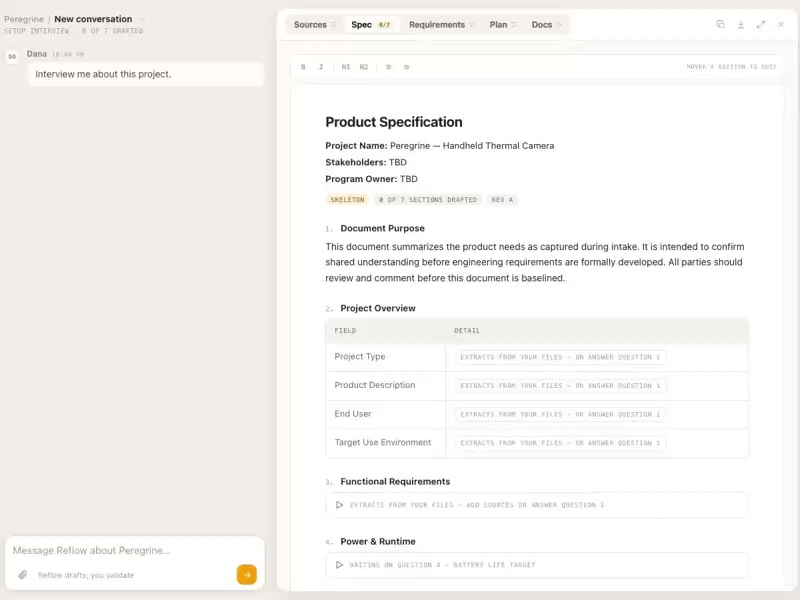
Chat on the left, the work on the right
When I joined, the paradigm was to have a chat panel on the right side of disparate views for plans, documents, and even chat itself. The experience initially felt confusing, and I realized the chats would also get lost inside documents. So I flipped it, making the chat the outermost parent element, and moved chat to the left side of the screen. I took inspiration from modern tools like Claude and Codex to design a global workspace on the right side. This new architecture greatly clarifies the interaction, and makes it easy for users to maintain multi-thread conversations within their projects. This also lays the groundwork for parallelization. I prototyped this vision in code and worked directly with our frontend and backend engineers as well as our PM and GM to make the vision a reality.
I really love this. It was very intuitive to me on opening up the first time.
Notes on method
I collaborate with my PM, then prototype with Claude
I proposed that we use a dual-track scrum approach, with a dedicated kanban for discovery and design. I wrote the first UX tickets and named the status states for our workflow. With this way of working, I collaborate with the PM and GM to understand the problem space each sprint, help conduct UXR discussions, and do problem framing together. We get aligned quickly at the start of the sprint, so I can start designing. I then prototype several variations in Claude, and discuss them with our PM. Together, we align on what’s working well, which options feel best, and where I should do further refinement within the design sprint. I also collaborate with our front-end engineer. I designed our design system and component library, which is now in Storybook. I work with the FE engineer to refine the system at a component level, so that we’re prototyping with a consistent visual language, but also so that if we discover a need for a new or modified component, we can approach that at a system level.
The outflow from this process feeds into the engineering sprints, often allowing them to pick up the code prototypes and move them quickly into delivery. I work closely with the PM to break the user stories into business logic and acceptance criteria. I am also comfortable shipping my own PRs, but in this engagement I have agreed to provide HTML prototypes along with defined user stories, which the ML and BE team can break down further for their own delivery sprints.
Credits
- Role
- Product designer, freelance
- Worked with
- Reflow’s product lead, leadership and engineering team
- Work
- Conversation and workspace model, agent behavior rules, HTML prototypes, user stories, design system
- Built with
- HTML prototypes made with Claude Code; Claude Design
Sample data shown here is illustrative.